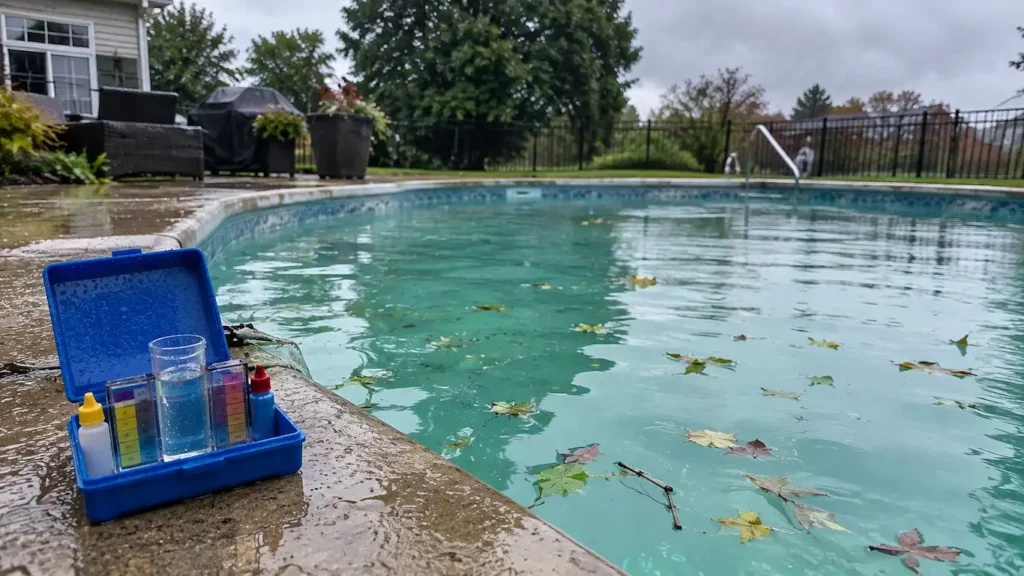
If you live in Western New York, you know heavy rain is just part of spring, summer, and fall. Storms can roll in quickly, and before you know it, your pool is overflowing with rainwater, dirt, leaves, and other debris. A downpour can dilute your pool chemicals and introduce organic material that increases chlorine demand, which can throw your water chemistry off balance.
After a storm, your pool water might turn cloudy, chlorine levels can drop, or the pH may move outside its normal range. Sometimes you may even notice a green tint if sanitizer levels fall low enough for algae to grow. That’s why, once the weather clears, it’s smart to check your pool chemical maintenance rather than just cross your fingers and hope for the best. For homeowners in Buffalo, Amherst, Cheektowaga, Tonawanda, and nearby Western New York communities, a quick post-storm check can help prevent a small water-quality problem from becoming a bigger one.
The Basics After a Storm
Storms bring all kinds of unwanted guests to your water: leaves, twigs, pollen, grass, dirt—whatever the wind can carry. Heavy rainfall can also dilute the chemicals already in your pool, while organic debris can increase chlorine demand. That combination can make it harder to maintain balanced water chemistry after a major storm. This is why checking your pool chemistry after a storm is an important part of post-rain pool care.
So, you go out to check your pool, and things look off. The pH may have changed, but there is no reliable rule that says rain will always make it go up or down. The result depends on your pool’s existing chemistry, alkalinity, source water, and how much rainfall entered the pool. Don’t just guess and start adding pool chemicals. Grab your test kit and get real numbers before you adjust anything. This is an important part of fixing pool pH after rain.
Ideally, you want the pH between 7.0 and 7.8 and the chlorine at a safe level. If the pH sours, chlorine just doesn’t work the way it should. That’s when germs and algae start getting comfortable.
When your pool gets cloudy after a downpour, it’s usually from all the junk that landed in the water or from chemicals getting knocked out of balance. Sometimes it’s as simple as dirty water from the backyard sliding in. Start with the basics, grab your net, test the water, and let the filter do its thing. These simple steps can help you fix cloudy pool water after rain buffalo homeowners often deal with after a heavy storm.
Step-by-Step: Getting Your Pool Back to Normal
- Check out the pool area. Before you throw any chemicals in, look around and scoop every last leaf or branch out with your skimmer. If you see dirt at the bottom, haul it out with the vacuum.
- Clean before you balance. Any leftover organic matter will keep eating up chlorine, making it harder to fix the water.
- Once things are clear, test your chlorine and pH. If you want to be thorough, check alkalinity, calcium, and stabilizer too.
- Don’t go wild with chemicals just because the water’s cloudy. You need to know exactly what’s off before you start adding stuff.
For regular homes, test chlorine and pH every time you deal with a big rain. The CDC says free chlorine should be at least 1 ppm if you don’t use cyanuric acid, or 2 ppm if you do. Always read the labels for whatever chemicals you use.
If the test says chlorine’s low, top it off according to the label. Depending on your water test results, you may need to add specific pool chemicals as directed. If things look really bad, like green or dull, you might use pool shock after rain, but don’t automatically shock after every storm. Only shock if your pool needs it and always follow the product instructions.
Not sure what to do? Better to ask a pro than risk burning out your pool or messing with strong chemicals. Handle pool chemicals carefully and follow instructions, always.
After you dose the water, keep the filter running so it traps all the fine particles still floating around. It takes time to clear up, sometimes a day or two, so be patient.
Still Cloudy?
Cloudy water means something still isn’t right. It could be lingering dirt, off-balance chemistry, or a filter that’s overdue for cleaning. Get rid of any leftover junk, retest, adjust, and keep the filter going. If the pool’s pressure is higher than normal, look up your filter’s cleaning or backwashing instructions.
And don’t throw every chemical in the shed at the problem; too much and you’ll never figure out what’s actually wrong.
If you’ve cleaned and balanced but still can’t see the bottom, it’s probably time to call a pool expert.
Green Water? Read This
A green pool is no one’s idea of summer fun. Rain doesn’t turn your water green by itself, but storms can make sanitizer levels drop and dump in extra dirt, perfect for algae.
If chlorine is super low, algae move in and start spreading. That’s when things start looking greenish.
First, don’t panic. Test the water, check the filter and pump, and figure out what needs fixing. It’s not just about adding more pool chemicals; pH, stabilizer, filtration, and water temperature all play a role. When in doubt, there are pool techs who can get things handled before it gets worse.
When To Get Professional Help
Sometimes you do everything right, and the water still won’t clear, or readings just keep bouncing. If the pool stays green, the pH is all over the place, or you just can’t get things balanced, that’s when you call for help.
A good pool tech will check the chemistry, look over your filter and pump, and figure out whether the problem’s debris, chemistry, or something mechanical.
With unpredictable Western New York storms, it’s never a bad idea to have an expert on call: KD Pool Builders at (716) 300-2773. Fixing a small problem early saves you from one big headache later.
Staying Ahead of the Storm
A little prevention helps. Keep gear and surroundings clean, and stay on top of your pool maintenance before and after storms. When bad weather hits, clear debris fast, test chemicals, check your filter, and let the pool run for a bit.
The CDC has good guidelines if you want more details about home pool water care.
Bottom line, don’t let heavy rain keep you out of your pool. Clean up quickly, take care of the chemicals, let the equipment do its job, and call in experts if you hit a wall. After all, pool season’s too short in Western New York to miss out because of a storm.
FAQs
Why does my pool look green or cloudy after rain?
Heavy rain washes in debris and dilutes the chlorine, letting algae get a foothold. That leads to green or murky water.
How do I get things back on track after a storm?
Scoop out debris, check and balance chlorine and pH, then run the pump and filter. If that doesn’t work, get a pro to take a look.
Should I always shock my pool after it rains?
Don’t make it automatic; test first. Shock is for when chlorine is really low, or there’s a lot of contamination.
Does rain make pool pH too high?
Rain can change your pH, but there’s no set rule; it can go up or down. Always check with a test kit before adjusting anything. This is why high pH in pool rain situations should be handled by testing rather than guessing.
How long till the pool clears up?
Depends on what’s wrong. With cleaning, balancing, and filtering, you’ll usually see clear water soon. If it’s still cloudy, call in a pool expert.
What pool chemicals should I check after heavy rain?
Test chlorine and pH first before adding pool chemicals. Depending on the results, you may also need to check alkalinity, calcium hardness, and cyanuric acid.